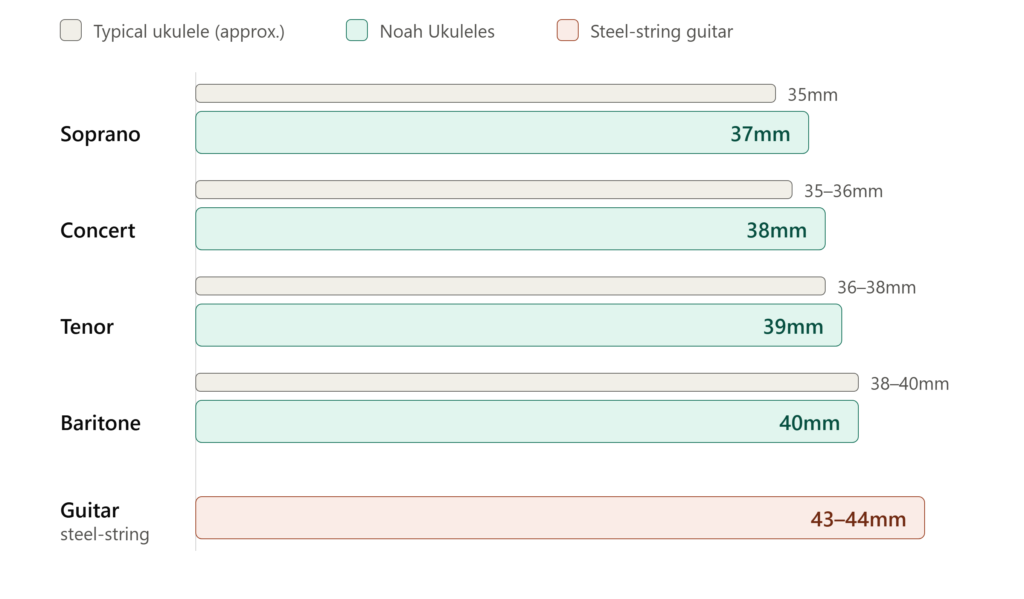
At Noah Ukuleles, we use nut widths that are typically 1–3mm wider than those found on many ukuleles of the same size. That’s deliberate, and it’s something I’d like to explain properly.
The short version: it came from listening to players, from my own preference, and from the views of people in the ukulele world whose opinions I really respect. Below I’ll explain a bit more about what nut width is, what difference it makes, and expand on why I think wider is best!
What is nut width?
The nut is the small strip of bone or synthetic material at the top of the fretboard, just before the headstock. It has four grooves that hold the strings in position. Nut width is the measurement across it, from one edge of the neck to the other.
It matters because it determines how much room there is to position the strings across the neck. A narrower nut generally means the strings sit closer together, while a wider one allows more room for them to be spaced apart.
Typical nut widths compared with ours
There’s no fixed standard. Every maker has their own specification. These are approximate figures for many traditionally proportioned ukuleles:
| Size | Typical nut width | Noah nut width | Difference |
|---|---|---|---|
| Soprano | 35mm | 37mm | +2mm |
| Concert | 35–36mm | 38mm | +2–3mm |
| Tenor | 36–38mm | 39mm | +1–3mm |
| Baritone | 38–40mm | 40mm | up to +2mm |
The gap is smallest on baritones, where many makers already use a wider neck. Our widths rise gradually with body size, so every model stays in proportion.
Why I went wider
There were three reasons, and they all pointed the same way.
Players told me. Customers kept mentioning how comfortable the necks felt, and how much easier it was to get clean chords.
It’s what I like to play. I simply prefer the feel of a little more room, and I wanted our ukuleles to be instruments I’d want to pick up myself.
People I respect agree. Players and reviewers I trust, including Barry Maz at Got A Ukulele, have taken a similar view of wider nuts. When your own experience, your customers and respected voices in the community all agree, it’s worth acting on.
Mr Anh, our head luthier, has been building ukuleles for over 30 years. He builds every Noah ukulele to these dimensions.
What difference does it make?
Cleaner chords. More space between the strings makes it easier to land each fingertip on its own string. That means fewer accidentally muted or buzzing notes, especially in chords where several fingers sit close together.
More comfortable playing. Your fingers don’t have to squeeze together to form a shape, which helps during longer sessions. For beginners especially, anything that makes chords less fiddly is definitely welcome.
Easier melodies. When you’re playing single notes across several strings, a little extra room makes it simpler to fret exactly the string you intend.
But what if I have small hands?
This is the question I get asked most. But while I understand someone being worried about this, I genuinely believe that even players with smaller hands will find a slightly wider nut more comfortable, not less.
The reason is simple. Plenty of people with small hands play guitar, and a steel-string guitar neck is around 43–44mm at the nut, which is significantly wider than any of our ukuleles. Even our widest neck, the 40mm baritone, is narrower than that. Our 37mm soprano is still a very compact neck.
The difference is subtle rather than dramatic. If you’ve played a particularly narrow-necked ukulele for years, you may notice a short adjustment period, but in my experience most people tend to instantly find it more comfortable to play.
Prefer a narrower nut? Just ask
I know some people have a strong preference, or simply want to stay with what they’re used to. If you’d love one of our ukuleles but really want a narrower, more standard nut width, get in touch. I take on custom build requests, and we can talk through what you’d like and what’s possible.
Questions about neck dimensions?
If you’re deciding between sizes, or wondering how a wider nut might feel for you, send me a message. I’m always happy to help. You can also browse our soprano, concert, tenor, and baritone ukuleles.